

Jörg Matysik
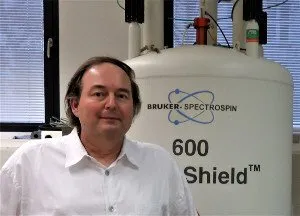
Jörg Matysik (誉宫) is born in Essen (Germany). Initially, Matysik went for vocational training as Chemielaborant in the Bergbau-Forschung (Institute for Coal Mining Research) in Essen-Kray (Steinkohlenbergbau-Verein). 1986/87 he was volunteer of „Aktion Sühnezeichen“ and worked in an Old-age home „Beth Achwa“ in Tel-Aviv Yad-Eliyahu.
Then he studied chemistry at the University of Essen, where he obtained his Chemie-Diplom (1992) under the supervision of Prof. Bernhard Schrader, working with infrared and Raman spectroscopy on tetrapyrroles.
During his studies, he went for an exchange semester to the Friedrich Schiller University Jena (Sept. 1990 – Feb. 1991) during German unification.
For his PhD (1995) he investigated the photoreceptor phytochrome with FT-Raman spectroscopy at the Max-Planck-Institut für Strahlenchemie (radiation chemistry) in Mülheim an der Ruhr in the group of Prof. Peter Hildebrandt in the department headed by Prof. Kurt Schaffner.
As JSPS and Humboldt fellow he worked with Raman spectroscopy on heme proteins in Prof. Teizo Kitagawa’s group at the Insitute for Molecular Sciences in Okazaki (Japan). From 1997 to 2012, he has been at the Leiden Institute of Chemistry. Initially he joined as Marie-Curie fellow and Casimir-Ziegler awardee the solid-state NMR sub-group of Prof. Huub J.M. de Groot belonging to the bio-organic photochemistry group of Prof. Johan Lugtenburg, and he became later assistant professor (universitair docent, UD) at that institute.
Since January 2013, he is full professor of analytical chemistry and molecular spectroscopy at the University of Leipzig.
Matysik is a recipient of the Jonge Chemici award (2001) and the Vidi award (2003) of the Nederlandse Organisatie voor Wetenschappelijk Onderzoek (NWO). He is member of the International Spin-Chemistry Committee and Associate editor of the journal „Applied Magnetic Resonance“. He was chair of COST action TD1103 on spin-hyperpolarization techniques in magnetic resonance (2013-2015).
Since 2013 Matysik is chair of Molecular Spectroscopy at the University of Leipzig. 2013 to 2026 he has been director of the Institute of Analytical Chemistry and head of the Aufbaustudium „Analytik & Spektroskopie“ at the University of Leipzig. Since 2013, he has been several times director and vice-director of the Leipzig Magnetresonanz-Zentrum (MRZ).
He was chair of the Fachgruppe Magnetic Resonance (FGMR) of the German Chemical Society (GDCh) from 2021 to 2024, is member of the FGMR-board 2021 to 2026, member of Committee of the Zürich-based Groupment AMPERE (since 2021), and counselor of the National Research Data Infrastructure consortium Chemistry (NFDI4Chem) since 2021.
In 2023, he was elected as Speaker of the DFG Collaborative Research Center (Sonderforschungsbereich, SFB) Transregio-386 „HYP*MOL“ Leipzig/Chemnitz.
Matysik had the great honor to join the foundation of the Network of Dutch scientists in Germany at the Royal Dutch Embassy in Berlin at 26 Oct. 2023 in the presence of the Minister for Culture and Science, the physicist Robert Dijkgraaf.
In summer 2022, Matysik was expert investigator at the Federal Administrativ Court (Bundesverwaltungsgericht) in Leipzig on the reliability of the analytical methods for COVID vaccinations (Soldatenprozess). Matysik is deputy expert member of the Enquete commission of the Landtag of Thüringen (parliament of the German federal State of Thuringia) on the Corona policy. In April 2026, he was requested to present his view of the analytical-chemical control by the federal German authorities to the Investigation commission of the Landtag of Sachsen (parliament of the federal State of Saxony).
My Entry in the German Wikipedia.de (although I feel honored) contains quite a bite fake statements. Serious presentation would be different 😉
At the end, human freedom will overcome -just by efficiency- all forms of totalitarism (faschism, Stalinism…). Lets enjoy our wonderful constitutions in Germany and its states.
ORCID number: 0000-0002-7800-7443